Evidence highlights

Wednesday, June 23, 2010

Moon anomalies P1—buried artifact


Report: #0155


In an image transmitted from Japan's Lunar Exploration Center, the JAXA/NHK image HDTV_004_1, a crater can be observed at first glance.

clip_image002

This crater was caused by a gigantic meteor impact. In such an impact, a hole forms in seconds. The typical crater is created. Hellish heat is produced. All the powdery mass evaporates, and the ground melts—whether rock or metals.

At the bottom of this hole, remnants of the cooling of this impact-produced lava are sometimes seen.

clip_image002[7]

But now, my question in this image: What material filled this first crater almost completely? Because there are at least three impacts.

In the first filling, the crater flooded until full, and on one part, at the lowest level of the wall, the excess mass began to spill out of the crater. In the middle of the crater, there was a metallic artifact that got trapped like in a well filling with mud. I assume the first impact did not produce this mass that filled the crater. Much later, water or lava emerged from inside the crater and covered it almost completely.  

clip_image002[9]

The image shows: An object, such as a pipe or part of a truck body, is half buried in a crater on the moon. This crater is filled with frozen water or cooled lava following a meteorite impact.

The conclusion is that there is or was volcanic activity on the Moon.

What artifact got trapped? 

Josef Bauer

The images are from the original report on my web Ovni-Digiart


Read rest of entry

Thursday, June 10, 2010

Storm Over Phoenix


Report: #0154


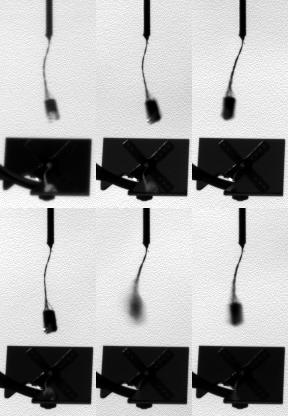
For the second time, a strong wind blowing over the Phoenix lander on Mars can be observed.


The timing measurement instrument, which normally remains motionless, moves almost horizontally due to wind gusts. Mars has, evidently, a much more active atmosphere than previously claimed, as has been discovered recently.  This atmospheric movement can mix layers of cold air with another warmer layer.

This causes an upward motion and atmospheric displacement.

When these layers meet at a certain height—which, in my opinion, will not be very high—condensation occurs, and due to its weight, it falls back to the surface as snow or rain. 

This is the beginning of a life cycle. If a little heat and water are added under these conditions—as we have already demonstrated—we are almost in a position to believe in a form of life.

Suppose the water does not have to be necessarily in liquid form. I suspect—and I will show images—that it involves biological forms like snails, capable of expelling a salty liquid from the mouth onto a block of frozen water. I'm referring to small amounts, similar to what a mosquito injects to attack blood and then sucks it back. In the same way, ice can be thawed by sprinkling a little salt on it and sucking it up again. That would be a very good way to use ice as a water source.

I would also like to ask again if anyone knows if Phoenix's microphone works. It would be interesting to hear the sound of a storm on Mars.

Josef Bauer

Read rest of entry

Friday, June 4, 2010

The ant that comes from Mars


Report: #0153


It looks like a supersonic ant.

This ant has no eyes on its head!

They found a species of ant that is genetically separate from the others. It has no eyes, which indicates that it lives underground.


There is an ant from Mars on Earth. Is there also an ant from Earth on Mars?

I think there are more exotic things on Mars. Soon I will show you a new series of biological life on Mars.


Josef Bauer

Read rest of entry
 

Kontakt: Josef Bauer

Followers

Time

Mars and UFOs Mysteries Copyright © 2009 Black Nero is Designed by Ipietoon Sponsored by Online Business Journal